






7-OH is primarily used for pain management, opioid withdrawal mitigation, and mood enhancement due to its action as a partial μ-opioid receptor agonist with 13-fold greater potency than morphine. You’ll find its abuse potential stems from preferential G protein pathway activation and demonstrated reinforcing properties, rats readily self-administer the compound in laboratory studies. The compound’s high μ-opioid affinity combined with prolonged hepatic stability creates conditions favorable for dependence development, which we’ll explore further below.
Understanding 7-OH: A Potent Kratom Alkaloid
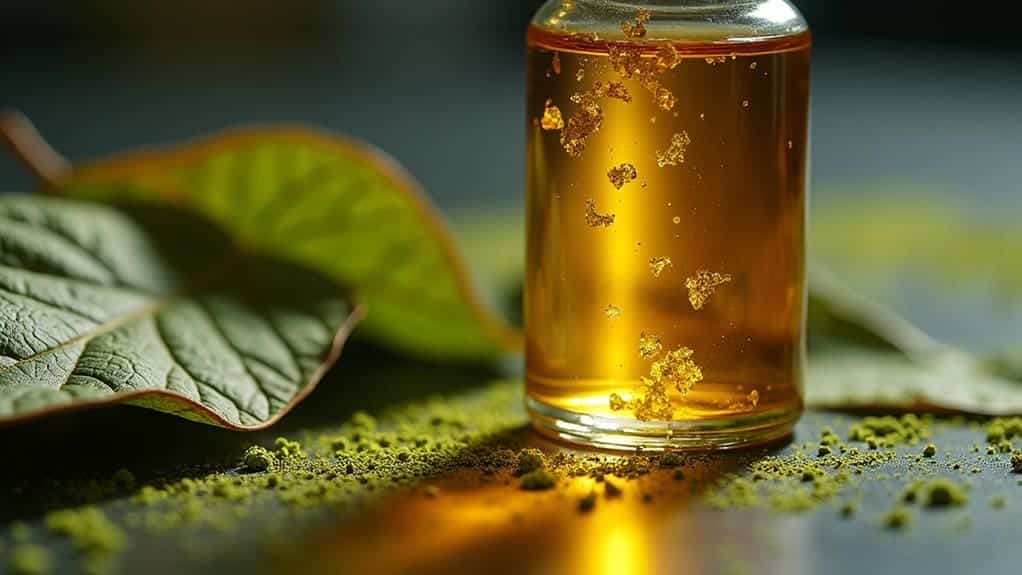
7-Hydroxymitragynine (7-OH) stands as one of kratom’s most pharmacologically significant alkaloids, despite comprising less than 2% of the plant’s total alkaloid content. You’ll find this indole alkaloid classified as a terpenoid derivative, with molecular structure analysis revealing properties that enable potent μ-opioid receptor interactions.
Pharmacokinetic modeling demonstrates 7-OH exhibits approximately 13-fold greater analgesic potency than morphine. This compound acts as a partial agonist at μ-opioid receptors while simultaneously antagonizing δ- and κ-opioid receptors, creating a pharmacological profile distinct from classical full agonist opioids. Beyond opioid receptors, 7-OH also affects dopamine, serotonin, and adrenergic receptors, contributing to its complex psychoactive profile. Research shows that rats self-administer 7-hydroxymitragynine, indicating the compound possesses reinforcing properties despite mixed findings in other reward measures. These opioid-like effects may produce respiratory depression that may lead to death, highlighting the serious safety concerns associated with this alkaloid.
Quantitative analyses confirm natural kratom contains roughly 0.005–0.04% 7-OH by weight. However, you should understand that concentrated extracts can reach 2.8% or higher, representing up to 500% enrichment compared to unadulterated plant material.
How 7-OH Works in the Body: Opioid Receptor Activity and Metabolism
When you consume kratom, 7-hydroxymitragynine (7-OH) enters your body through two routes: direct ingestion of trace amounts present in the plant and, more substantially, hepatic conversion from mitragynine via CYP3A enzymes. Once in circulation, 7-OH binds to μ-opioid receptors (MOR) as a partial agonist with 5–14-fold greater affinity than its parent compound, activating G-protein signaling pathways while showing minimal β-arrestin-2 recruitment. This G-protein–biased receptor activation drives the compound’s potent analgesic effects and distinguishes its pharmacological profile from classical opioids like morphine. In antinociception assays, 7-hydroxymitragynine demonstrates forty-fold greater potency than mitragynine and tenfold greater potency than morphine. Additionally, 7-OH acts as a competitive antagonist at δ- and κ-opioid receptors, which contributes to its unique receptor binding profile compared to traditional opioid agonists. Because mitragynine functions as an atypical opioid agonist, its metabolic conversion to 7-OH significantly amplifies the overall opioid activity experienced after kratom consumption.
Opioid Receptor Binding Mechanism
How does a compound derived from kratom produce effects rivaling those of classical opioids? The answer lies in 7-OH‘s receptor binding selectivity and unique signaling properties.
7-OH binds mu-opioid receptors with high affinity (Ki ≈ 7–37 nM), approaching morphine-level binding strength while showing preference over delta and kappa receptors. This selectivity drives its potent analgesic effects. Studies demonstrate that 7-OH provides 13 times greater pain relief than morphine in guinea-pig ileum preparations, highlighting its remarkable potency.
What distinguishes 7-OH from traditional opioids is its G protein biased agonism. When you examine its signaling profile, you’ll find it preferentially activates G protein pathways while minimizing β-arrestin recruitment. This bias produces strong analgesia with potentially reduced adverse effects like respiratory depression. Research on analogs like 11-F-7OH demonstrates that C11 position modifications can fine-tune this signaling efficacy, offering pathways toward safer opioid therapeutics.
Despite functioning as a partial agonist with Emax ≈ 22–47% relative to full agonists, 7-OH achieves morphine-comparable analgesia in vivo at doses of 0.25–0.6 mg/kg. Importantly, 7-OH is formed from mitragynine through conversion mediated by cytochrome P450 3A isoforms in both mouse and human liver preparations, making metabolism a critical factor in determining kratom’s overall activity.
Liver Metabolism Pathway
Once mitragynine enters your bloodstream, your liver’s CYP3A4 enzymes rapidly convert it to 7-OH through oxidation at the indole ring’s 7-position. Human liver microsomes demonstrate greater efficiency in mitragynine metabolism compared to mouse microsomes, highlighting significant species-dependent pharmacokinetics.
CYP3A enzyme importance extends beyond initial formation. Once generated, 7-OH exhibits remarkable hepatic stability, with over 90% remaining intact after 40 minutes in human liver microsomes. This resistance to further Phase I oxidation translates to prolonged hepatic residence time and potential accumulation of this potent metabolite. This accumulated 7-OH then acts as a partial agonist at μ-opioid receptors while simultaneously antagonizing δ- and κ-opioid receptors, producing its characteristic analgesic and euphoric effects.
Your plasma also contributes to 7-OH’s fate through non-hepatic pathways. Protease-mediated degradation, involving cysteine proteases, metalloproteases, and calpain proteases, converts 7-OH into mitragynine pseudoindoxyl and other degradation products, representing extrahepatic biotransformation routes distinct from traditional hepatic metabolism. Notably, 7-OH demonstrates significantly lower stability in human plasma compared to rodent and monkey plasma, with a half-life of only 98.7 minutes.
Common Uses of 7-OH Products in the Unregulated Market

You’ll find 7-OH products marketed primarily for three overlapping purposes in the unregulated market: pain management, opioid withdrawal mitigation, and mood or sedation enhancement. Consumers use these concentrated formulations to self-treat chronic pain conditions, manage opioid dependence symptoms without medical supervision, and achieve anxiolytic or sedative effects at higher doses. These products are commonly sold in gas stations, smoke shops, and various online venues, making them easily accessible to consumers seeking alternatives to regulated substances. The unknown concentration levels of 7-OH in these products make it impossible for users to gauge safe dosages, increasing overdose risk significantly. Products may also be packaged as fruit-flavored gummies and ice cream cones, making them particularly appealing to children and teenagers. Understanding these common applications helps clarify why 7-OH carries significant abuse liability despite its positioning as a natural wellness product.
Pain Relief Applications
Where does 7-OH fit within the unregulated pain relief market? You’ll find vendors positioning this potent μ-opioid receptor agonist through aggressive pain relief marketing that targets individuals with chronic musculoskeletal conditions, including back pain, joint dysfunction, and arthritis. These products appear as tablets, gummies, liquid shots, and powders in convenience stores, gas stations, and online platforms.
Pain medication substitution drives much of 7-OH’s appeal. If you lack healthcare access or find prescription analgesics cost-prohibitive, you may encounter these products marketed as “natural” alternatives to pharmaceutical opioids. However, this framing obscures critical pharmacological facts: 7-OH demonstrates higher potency than morphine at μ-opioid receptors. You should recognize that no FDA-approved indications exist, and no clinical trials have established safety or efficacy for pain management in these unregulated formulations. The FDA has confirmed that 7-OH is not a lawful dietary supplement, food additive, or ingredient in any approved drug product. The serious risks associated with these products are evident, as 6 fatal overdoses linked to 7-OH have been reported in Los Angeles County alone.
Opioid Withdrawal Self-Treatment
Thousands of individuals seeking to manage opioid withdrawal symptoms turn to 7-OH products as an alternative to medically supervised treatment. You’ll find these compounds marketed as prescription medication alternatives to buprenorphine and methadone, particularly when formal treatment access remains limited.
7-OH’s potent mu-opioid receptor agonism enables suppression of withdrawal manifestations, including anxiety, muscle aches, and cravings. Users seeking opioid cessation support often select 7-OH-enriched products specifically for their ability to mimic traditional opioid effects during abrupt discontinuation.
However, this self-treatment approach carries substantial risks. You’re substituting one dependence-forming substance for another, as 7-OH’s high receptor affinity produces its own withdrawal syndrome. Unregulated product variability compounds these dangers through inconsistent dosing and potential contamination, making safe tapering protocols virtually impossible without clinical oversight.
Mood and Sedation Effects
Beyond withdrawal management, 7-OH products have gained traction in unregulated markets for their mood-altering and sedative properties. You’ll find these compounds marketed for relaxation, anxiety relief, and insomnia management despite lacking FDA approval for any therapeutic indication.
The mu-opioid receptor agonism underlying 7-OH’s effects produces dose-dependent sedation and euphoria, engaging reward pathways associated with abuse liability. Animal studies confirm opioid-like self-administration patterns, supporting concerns about dependence development.
Key concerns you should understand include:
- Sedative potentiation: Combining 7-OH with alcohol or benzodiazepines dramatically increases respiratory depression risk
- Emotional instability: Reported adverse effects include anxiety, irritability, and mood dysregulation during use and withdrawal
- Rebound symptoms: Discontinuation triggers insomnia and heightened anxiety, perpetuating use cycles
- Tolerance escalation: Progressive dose increases occur as users chase initial sedative effects
Why 7-OH Carries Significant Abuse Potential
Potency fundamentally distinguishes 7-hydroxymitragynine from conventional kratom alkaloids and drives its heightened abuse liability. 7-OH functions as a high-affinity agonist at μ-opioid receptors, the same molecular targets responsible for morphine’s analgesic and euphoric effects.
With analgesic potency estimated at approximately 13 times that of morphine, 7-OH produces strong reinforcement at relatively low doses. This pharmacological profile accelerates tolerance development, compelling you to increase consumption rapidly. Animal self-administration studies confirm 7-OH activates the same reward circuitry as classical opioids, establishing compulsive consumption patterns characteristic of substance use disorders.
Concentrated product formats, extracts, tablets, and shots, deliver 7-OH at levels far exceeding natural kratom content. Combined with inconsistent labeling and variable batch potency, this creates dangerous overdose risks. You face narrowed safety margins between desired effects and toxic exposure.
Health Risks, Adverse Effects, and Dependence Associated With 7-Oh
Exposure to 7-hydroxymitragynine triggers a constellation of adverse effects spanning multiple organ systems, with severity escalating dramatically at concentrated doses found in extract products. You face immediate risks including respiratory depression, tachycardia, hypertension, and seizures. Polydrug toxicity risks multiply exponentially when you combine 7-OH with benzodiazepines, alcohol, or other sedatives.
Key health concerns you should recognize:
- Dependence liability: Strong mu-opioid receptor binding produces withdrawal syndromes requiring clinical intervention
- Mental health implications: Anxiety, depression, and cognitive impairment emerge during both intoxication and cessation
- Overdose potential: Unregulated product variability creates unpredictable 7-OH concentrations
- Systemic toxicity: Cardiovascular stress, neurologic dysfunction, and gastrointestinal distress occur acutely
Chronic use establishes opioid use disorder patterns, with naloxone-responsive overdoses confirming pharmacologic equivalence to traditional opioids.
Regulatory Status and Public Health Concerns Surrounding 7-OH
The federal government has taken increasingly aggressive action against 7-hydroxymitragynine, with FDA declaring in July 2025 that the compound warrants Schedule I classification under the Controlled Substances Act, a designation reserved for substances with high abuse potential, no accepted medical use, and inadequate safety data.
| Jurisdiction | Current Status |
|---|---|
| Federal (FDA) | Recommended Schedule I; products deemed adulterated |
| Federal (DEA) | Rulemaking pending; final authority retained |
| Florida | Emergency ban effective August 2025 |
| North Carolina | No specific restrictions |
| Virginia | Health advisories issued |
The enforcement landscape reflects coordinated federal action, including product seizures and warning letters to seven companies. You should understand that the legal landscape varies extensively by state, with Florida pursuing permanent scheduling while other states maintain minimal restrictions on 7-OH products.
Take the First Step Toward Recovery Today
Frequently Asked Questions
Can 7-Oh Be Detected on Standard Workplace or Probation Drug Tests?
Standard workplace testing policies don’t typically detect 7-OH, as routine 5-panel and 10-panel immunoassays aren’t calibrated for mitragynine or its metabolites. You’ll likely pass conventional employment screens. However, probation officer protocols may include kratom-specific LC-MS/MS panels, particularly in states with kratom restrictions. If you’re under court-ordered supervision, your risk escalates considerably, specialized assays reliably identify 7-OH when specifically targeted, especially in safety-sensitive or legal monitoring contexts.
How Long Does 7-Oh Remain Detectable in Urine or Blood Samples?
You can expect 7-hydroxymitragynine to remain detectable for varying periods depending on the sample type. Urine detection timeframes typically range from 5–7 days, extending to 9 days with heavy or chronic use. Blood detection timeframes are considerably shorter, generally up to 24 hours post-ingestion. Factors including dose frequency, metabolic rate, body composition, and renal function greatly influence your individual clearance rates and detectability windows when specialized LC-MS/MS testing is employed.
Does 7-Oh Interact Dangerously With Prescription Antidepressants or Anti-Anxiety Medications?
Yes, 7-OH interacts dangerously with prescription antidepressants and anti-anxiety medications. You face significant risks of combining 7-OH with prescription drugs due to CYP2D6 and CYP3A4 enzyme inhibition. Potential interactions with other medications include serotonin syndrome with SSRIs like fluoxetine, toxic benzodiazepine accumulation, and documented fatal outcomes with quetiapine. Tricyclic antidepressants such as amitriptyline have demonstrated hepatic complications. You should disclose 7-OH use to your prescriber immediately.
Is 7-Oh Legal to Purchase and Possess in All U.S. States?
No, you can’t legally purchase or possess 7-OH in all U.S. states. The legal status varies considerably across jurisdictions. Florida has implemented emergency regulations explicitly banning 7-OH products, while California prohibits kratom and 7-OH in foods and dietary supplements. Possession requirements remain uneven nationally. Federally, the FDA classifies 7-OH as an illegal, unapproved opioid product, and the DEA is currently reviewing Schedule I placement recommendations, creating significant legal exposure regardless of state-level provisions.
Can Naloxone Reverse an Overdose Caused by 7-Oh Consumption?
Yes, naloxone can reverse a 7-OH overdose. Since 7-OH acts as a potent μ-opioid receptor agonist, naloxone competitively displaces it from these receptors, restoring respiratory function. If you observe overdose symptoms, respiratory depression, unresponsiveness, or pinpoint pupils, administer naloxone immediately. However, because 7-OH products lack standardized dosage guidelines, you may need repeated naloxone doses due to variable potency and duration of action compared to conventional opioids.